Walter's Random Musings
Jazz Age Social Dancing ("The Modern Dances")
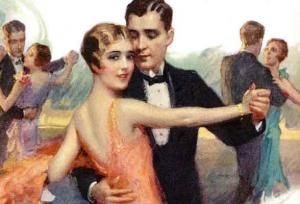 In the Jazz Age, nearly everyone danced, so they did dances almost anyone could do.
Generally, when people think about the dances of the Jazz Age (the 1920s & 30s), they bring to mind exuberant youth dances like the Charleston or Lindy Hop, or the theatrical dances of Fred and Ginger.
What Fred & Ginger did was theater and spectacle, and was never intended to be an accurate representation of how ordinary folks danced. Countless examples of normal, workaday social dancing can be seen in movies of the period but not being done by exhibition dancers like Fred and Ginger. If you want to see how it was really done, look at the folks in the background or characters who are dancing to move the story along rather than to show off their skills.
The most common misconception however is our tendency to assume that everyone, regardless of age, social status, ethnicity or geography was dancing the latest fad youth dance of the moment: be it the Charleston, the Black Bottom, Collegiate Shag or Lindy Hop. Given the complexity and physical demands of these dances, this defies simple logic; and any review of the films of the time will show that these youth dances had a definite place, but they were danced by a minority of the total dancing population - and even those who danced them did not limit themselves to those dances (unlike many current dancers).
Set Dancing and Eye Contact
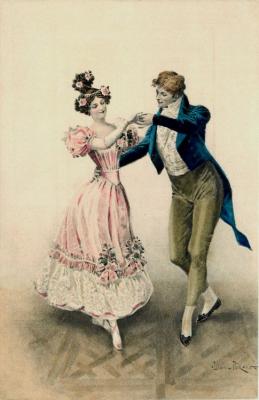 I recently attended a Regency-themed English Country Dance in a place far from home. It was a beautiful historic venue, the music was good, everyone was well dressed and the dancers were capable, but there was something lacking, something that left me unsatisfied. It became especially clear what it was when it was remarked upon by one of the local ladies: almost nobody made eye contact.
We went through our figures, took hands on cue and even did some fancy steps from time to time, but almost every time, as I took hands with another person, my eyes were looking at the side of her head while her attention was elsewhere.
This really brought home to me how essential this was: that eye contact in a set dance, whether it was English Country Dance, Contra Dance, Quadrilles, Square Dancing, Scottish Country Dance etc., is not a minor stylistic detail. It is key. In my personal reckoning, the most important thing is correctly following the figure and the music (nothing works if you aren't where you need to be) and the second, and still essential piece, is eye contact.
This is what makes it a "social dance". The whole point of dancing in a group is connecting with the other members of that group. If you hit all your marks and perform all your mechanical functions when you are supposed to do them, while keeping your eyes fixed ahead; you are not undermining the working of the dance, but you are off in your own world. You are dancing with yourself. The group is dancing together, while you are not fully present. You are just an anonymous cog in the machine, while those who make eye contact are fully present and are connecting with one another. Further, since those who make eye contact are, as I said, fully present, they are better able to coordinate their movements with the other dancers - which makes even the mechanical parts of the dance work more smoothly.
Remembering the Centennial of the End of the Great War
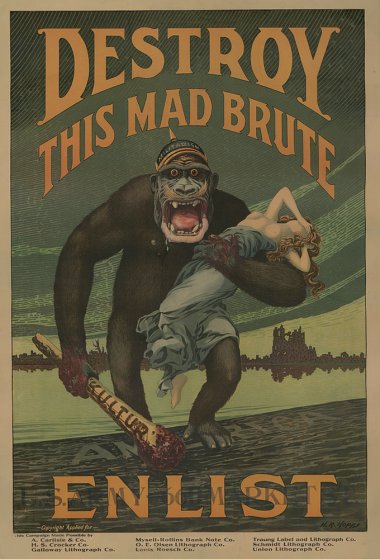 On November 11th, 2018, we will reach the centennial of one of the most portentous dates in human history. On that day, in 1918, the guns fell silent and the killing stopped and World War One, known as “The Great War” before another world war came along, came to an end.
It’s a problematic anniversary. It was one of the defining moments in world history, and it seems like it should be commemorated, but how to do it?
In 1914, there were four emperors who went to war, in Russia, Germany, Austria-Hungary and Turkey. After 1918, Russia was in a bloody civil war from which would emerge the Soviet Union, Germany was setting up a fragile democracy, Austria-Hungary was smashed into its constituent parts, and Turkey’s Ottoman Empire was divided up by Britain and France in a way that set the stage for today’s troubled Middle East.
Further, the vindictive and arbitrary terms of the Treaty of Versailles led directly to the rise of the Nazis, and the even more murderous Second World War.
In the “victorious” powers, victory was really just relief and exhaustion. A whole generation was decimated in France and Britain, and there was a general sense not of victory, but of failure – a sense that the old-fashioned values of service, sacrifice, loyalty and patriotism that had motivated those young men to march off to war had all been a lie. The “lost generation” could not really see how it had all been worth it.
Even in America, which had been involved in active fighting for only a few months, the war had its impact. Those few months had been a literal hell for the Americans who actually saw combat, and the Doughboys returned not only with a broader, less provincial view of the world; but with an angry cynicism much like their French and British brothers.
This also coincided with the Spanish Influenza, which killed in the space of a year, even more people than the war.
So, now this centennial is upon us. What do we do about it?
Mrs Murphy's Waltz - A Rediscovered Family Treasure
Found in the Murphy family papers: a Waltz from 1880 by a great grandmother of a member of the Social Daunce Irregulars committe: the Once Again Waltz by Mrs. R. G. Murphy (nee Ellie Jameson). We asked Dean Mora to work it up and, for the first time in over a century, here it is.
The Ballroom Scene from "I Don't Want to be a Man" - 1918
Ernst Lubitsch frequently inserted comical dance scenes into his films, and this is no exception.
The premise is that a young lady, unhappy with her lot, impersonates a man. She then finds out it's not all it's cracked up to be.
This film provides a wonderful snapshot of Ragtime era Fox Trot/One Step.
The Rules for Croquet: 1865
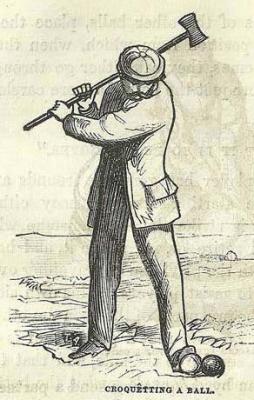 Croquet is a very popular pastime in the historical costuming community. We set up a picnic, we deploy our wickets and start smacking our balls.
However, we generally use the rules we know from our youth - and this is not necessarily as it was done in the mid 19th Century when it was at the height of its popularity.
Linked from this page is a facsimile scan of a pocket-sized book on how Croquet was played in the Victorian era around the time of the American Civil War.
How to Play Croquet: A New Pocket Manual of Complete Instructions for American Players
Illustrated with engravings and diagrams
Together with all the rules of the game, hints on parlor croquet and a glossary of Technical Terms.Boston, Published by Adams and Company. 1865.
(Authorship unknown).
I would like to thank my talented friend Tim Steinmeier for this beautifully executed facsimile scan of a book that was provided by the International Printing Museum in Carson California, where Tim is a volunteer.
Download the book
Foxtrot Part 3: The King of All Dance
From the 1920s until the early '50s, every dance piece in 4/4 time, whether it was Charleston, Black Bottom, Swing or even Rock and Roll, was published as "Fox Trot". Here is a brief slideshow/montage illustrating that fact.
The Muybridge Waltzes: Clothed and Unclothed - 1887
This is my animation of three of Eadweard Muybridge's "Animal Locomotion" studies from 1887. He pioneered a technique of capturing movement using multiple high speed cameras. It was originally developed to settle a bet between millionaires, but he then went on to use it to capture the motion of humans and animals doing any number of things. Given how concealing and constraining Victorian clothing was, he frequently made use of nude models. In the case of the naked dancing couple, a plausible explanation is that Victorian sensibilities would be too shocked by a naked man and woman dancing together, so he opted for two naked women as being less scandalous.
These represent the earliest moving images of social dancing. Films are easy to find for students of 20th Century dance, but for those studying the social dance of the 19th Century, this is really all there is. They were, of course, originally multiple still images, but when you put them together, they become a motion picture.
The original studies consisted of consecutive shots of people dancing a Waltz. In my animation, first I show them frame by frame and then speed it up to get a sense of motion. It includes three studies: a clothed man and woman, two nude women waltzing together and one nude woman waltzing alone.
If we can get past the "Oh, naked ladies" reaction, there's actually much to be learned from these videos.
A Collection of Vintage Adult Book Cover Art
| This particular posting will be something of a departure for me, though I suppose it does have some connection to "Social History".
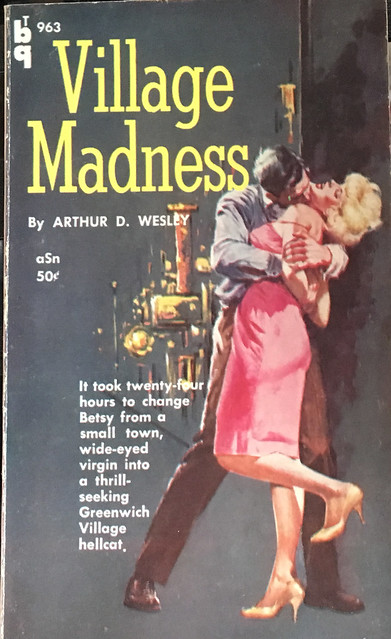
In the process of dealing with the estate of a deceased relative, I came upon several stashes of "vintage" adult literature - perhaps 600 volumes in total. Much is cheaply produced and, well, just porn; but about half of it dates from the late '50s through the late '60s, when "adult" literature often had cover art that ranged from crude but enthusiastic to expertly executed - clearly produced by the same talented artists who were doing cover art for more "respectable" paperback books. Alas, much of it was too water damaged to even scan, so this collection is the survivors. So, here they are, posted to Flickr in no particular order. They are an interesting snapshot of a moment in our history, at the cusp of the "Sexual Revolution", when euphemisms abound and the word "Shame" figures prominently in the cover text of many of them; but many others aren't ashamed at all. Note: there's one exception to the timeline. You will see a few that date from the '30s and '40s, but mostly it's the late '50s and '60s. Since a big part of what I do for a living is digitizing stuff (I'm really fast) and the collection was about to be broken up forever in an estate sale, I decided to capture it while I could in all its infinite strangeness. There are over 460 items in the collection. PS: I also included the scan of the back cover of one of the books, containing a note that apologizes for not being able to use the mail. I suspect that is related to the draconian laws then in effect relating to sending pornography through the mails.
|
|
The Gigolo's Tango
The signature dance of the gigolo, as depicted in a selection of old movies. A nice review of what a polished Tango looked like in the '30s and '40s.